Travel guide
Lumbini Monasteries 2027: The 15 Best Temples, Timed Routes and Honest Costs
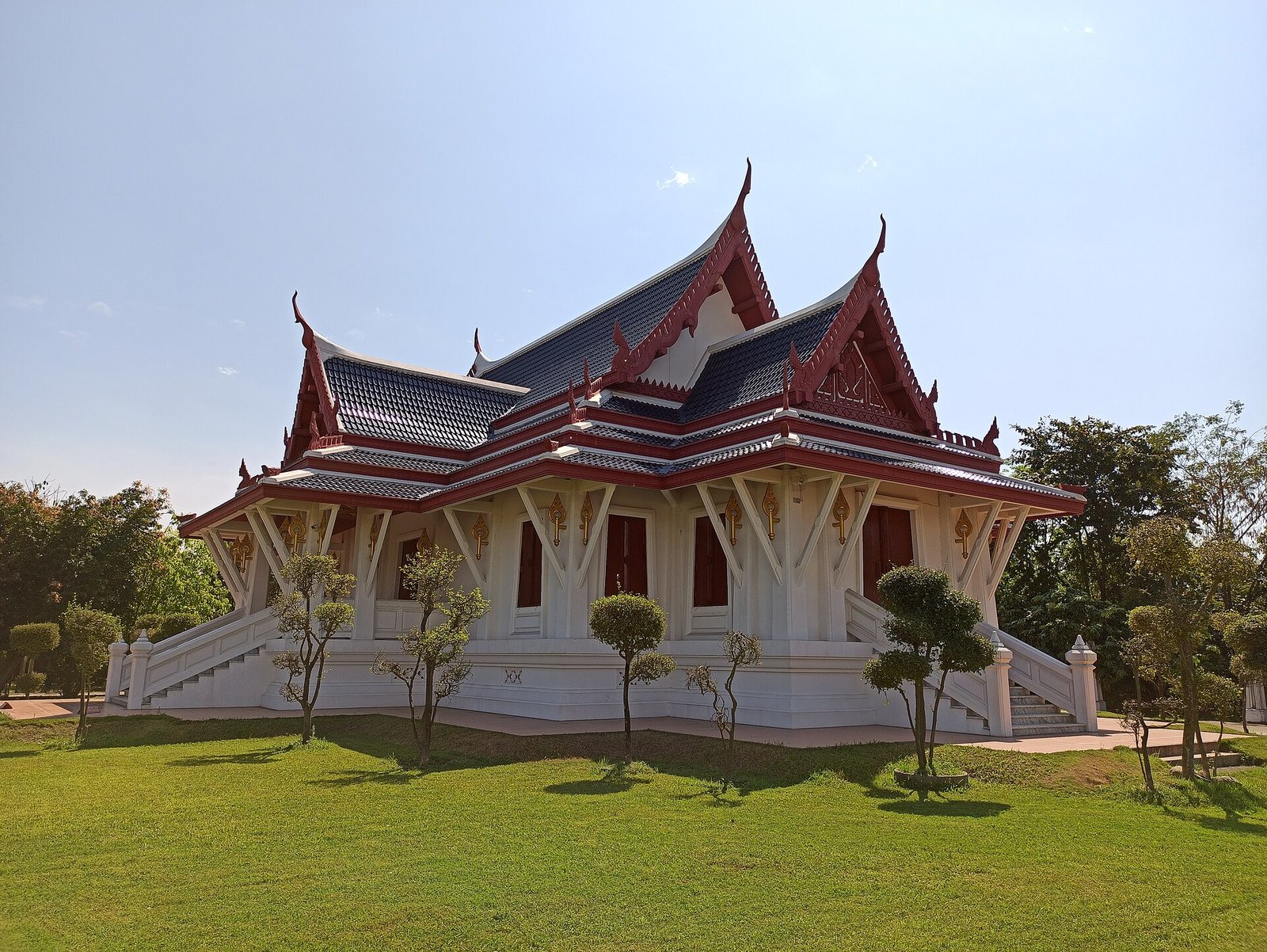
The Lumbini monasteries are about 30 Buddhist temples built by countries and communities from across Asia and beyond, in a planned zone north of the Buddha’s birthplace, and you can see the best of them in half a day by bicycle or e-rickshaw.
One walk, a whole Buddhist world.
Most people come for the Maya Devi Temple, then look at the map and feel lost. The monastic zone is big, flat and spread out. Some temples are huge and golden, some small and quiet, and many close at lunch. So visitors often rush through five buildings in the midday sun, or give up.
This guide covers Kenzo Tange’s master plan, the East and West zones, the 15 monasteries most worth your time (with honest ratings), opening times, dress code and photo rules, the Eternal Peace Flame and the canal boat, the World Peace Pagoda, the museum and the Crane Sanctuary, getting around and what it costs, and two timed routes. For rooms and current entry fees, read our guide on where to stay for Lumbini.
“We have one day in Lumbini. There seem to be dozens of monasteries. Which ones are really worth seeing, and how do we get between them without melting?”
A question travellers often ask our family
Quick answer: Start early. See the East zone first (Myanmar Golden Temple, Royal Thai Monastery), cross the canal to the West zone (Chinese, Korean, Great Lotus Stupa, Vietnamese), rest from about 12 to 2 when many temples close, then ride north to the World Peace Pagoda for sunset. Hire a bicycle or e-rickshaw, and cover shoulders and knees.
In This Guide
- What are the Lumbini monasteries, and how is the zone laid out?
- East or West: what is the difference?
- The monastic zone at a glance
- The 15 Lumbini monasteries most worth seeing
- Which monasteries should you see first?
- When are the monasteries open?
- Etiquette and dress code
- Can you take photos inside?
- The Eternal Peace Flame, the canal and the boat
- Is the World Peace Pagoda worth the ride north?
- The Lumbini Museum and the research institute
- The Crane Sanctuary
- How do you get around, and what does it cost?
- A half-day monastery route
- A full-day route
- Meditation centres and monastery stays
- Best season and time of day
- Visiting the monasteries from Greenkunja
- How Greenkunja and GoIndiaNepal fit in
1. What are the Lumbini monasteries, and how is the zone laid out?
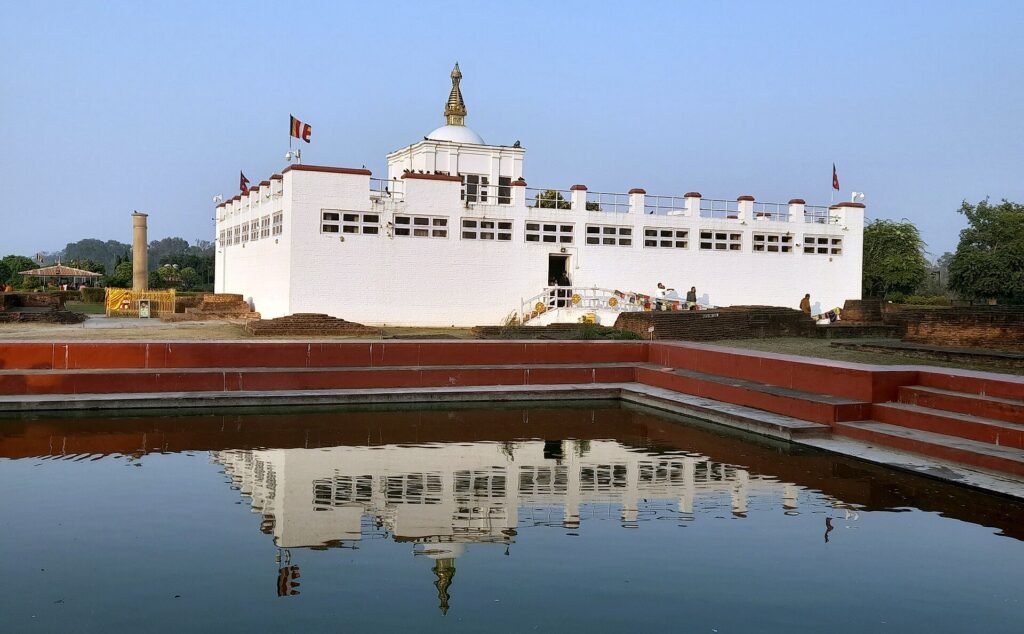
In 1967 the UN Secretary-General U Thant, a Buddhist from Burma, visited Lumbini and asked the world to help develop it. The Japanese architect Kenzo Tange began a master plan in 1972, and Nepal approved it in 1978. The Lumbini Development Trust, set up in 1985, still builds the site under that plan, which is not finished today.
The plan is about 1 mile wide and 3 miles long (roughly 1.6 km by 4.8 km), on a straight north–south line, with three parts of about one square mile each:
- The Sacred Garden in the south: the Maya Devi Temple, the Ashoka Pillar and the holy pond
- The Monastic Zone in the middle, where countries and Buddhist groups build temples
- The Cultural Centre and New Lumbini Village in the north: the museum, the research institute, the World Peace Pagoda and the Crane Sanctuary
A canal and a 1.6 km walkway run through the monastic zone and join the three parts. As Nepali Times explains, the museum anchors the north end and the birthplace the south. Only monasteries may be built in the monastic zone, so there are no shops or hotels between the temples.
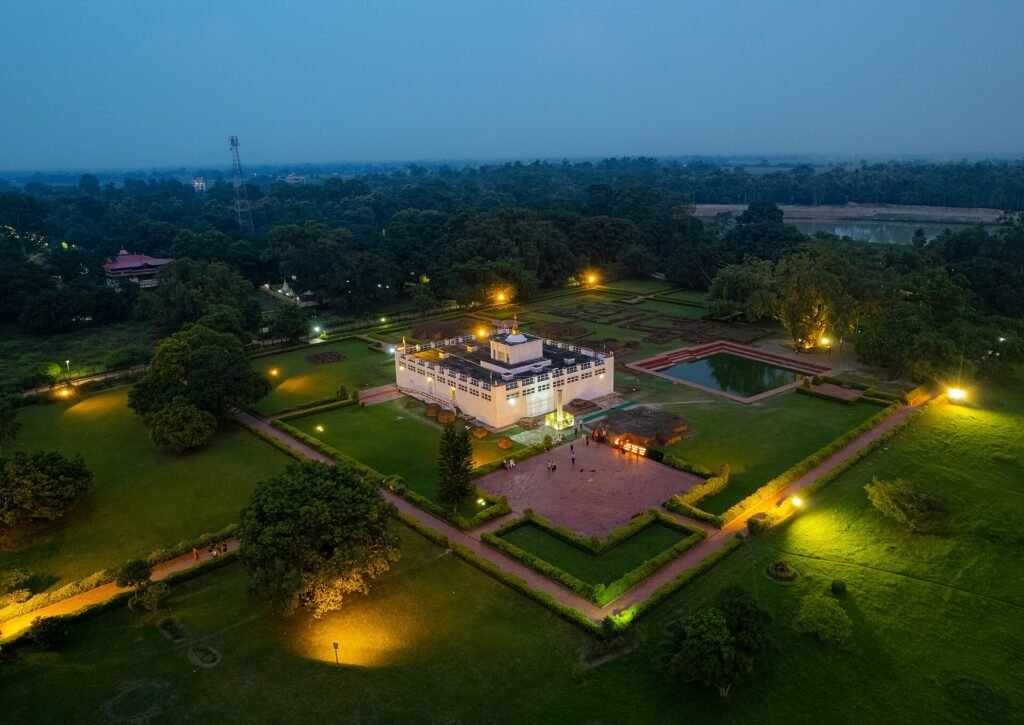
Insider tip: Think of the zone as a long ladder: the canal is the middle, the temples are the rungs, and the Sacred Garden and the Peace Pagoda are the two ends.
2. East or West: what is the difference?
The canal splits the monastic zone into two halves, each for a different branch of Buddhism.
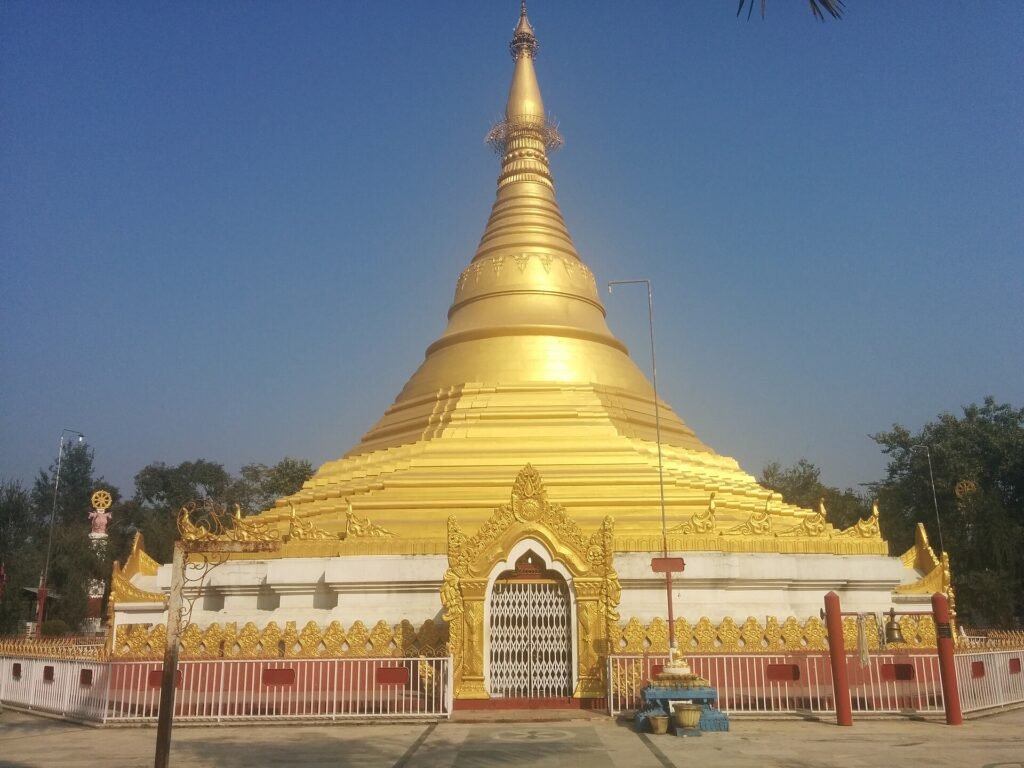
The East Monastic Zone is for Theravada Buddhism, the tradition of Sri Lanka, Myanmar, Thailand and Cambodia. Temples tend to be white or golden with tall spires, and the feeling is simple and calm.
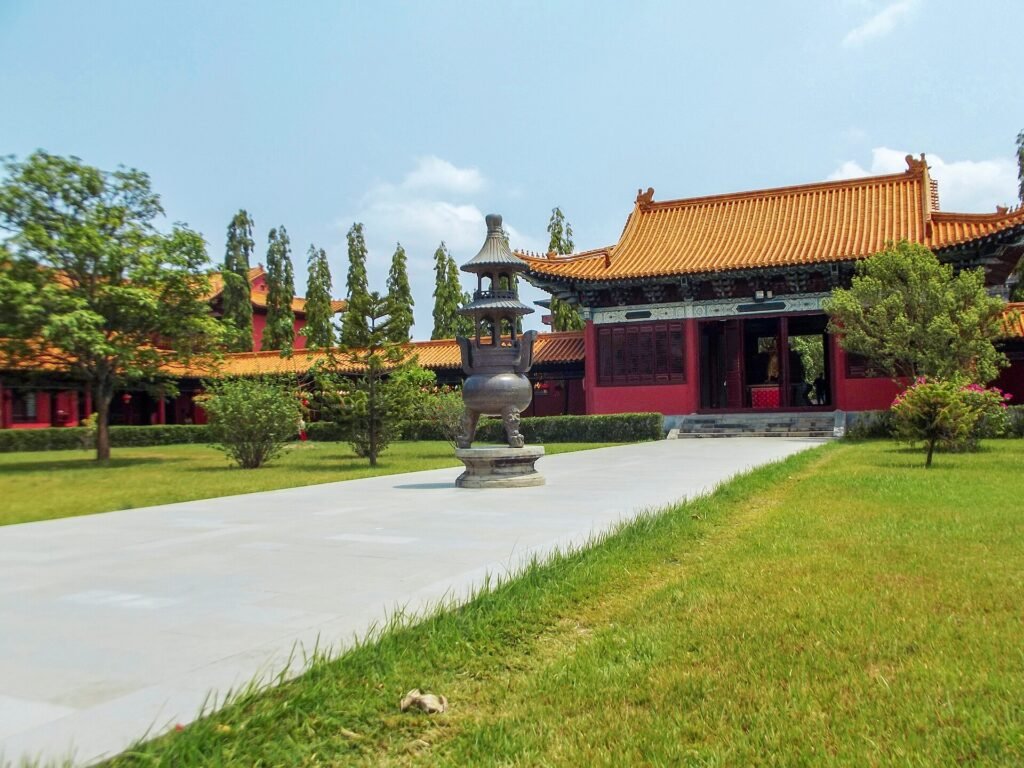
The West Monastic Zone is for Mahayana and Vajrayana Buddhism, from China, Korea, Japan, Vietnam, Tibet and the Himalaya. It is larger and busier, with red and gold halls, painted ceilings, prayer wheels and big statues.
| East zone (Theravada) | West zone (Mahayana and Vajrayana) | |
|---|---|---|
| Plots | 13 | 29 |
| Traditions | Sri Lanka, Myanmar, Thailand, Cambodia | China, Korea, Japan, Vietnam, Tibet, Nepal |
| Look and feel | White marble, golden spires, simple halls | Painted ceilings, red and gold, big statues |
| Best-known | Myanmar Golden Temple, Royal Thai | Chinese, Korean, Great Lotus Stupa |
| Crowds | Usually calmer | Busier |
The Nepal Tourism Board counts about 32 monasteries and meditation centres built or being built on the 42 plots, so you will see scaffolding in places.
Insider tip: Short on time? Choose the West zone for variety or the East zone for quiet. Better still, do one in the morning and one in the afternoon.
3. The monastic zone at a glance
| What | Details |
|---|---|
| Master plan | Kenzo Tange, approved 1978; still being built |
| Size | About 1.6 km by 4.8 km |
| Monasteries | About 32 built or under construction on 42 plots |
| Entry to monasteries | Free; a small donation is welcome |
| Zone entry fee and rooms | See our Lumbini stay and fees guide |
| Time needed | Half a day for 5–6 temples; a full day for both zones and the Peace Pagoda |
| Getting around | Bicycle or e-rickshaw |
| World Heritage | The birthplace has been a UNESCO World Heritage Site since 1997 |
Insider tip: Carry small notes for donation boxes, and give what feels right.
4. The 15 Lumbini monasteries most worth seeing
You do not need to see every building. These 15 each look and feel different. Zones and countries follow the Lumbini Development Trust’s list.
East zone (Theravada)
1. Myanmar Golden Temple (Myanmar). One of the oldest buildings in the zone. Its corn-cob spire follows the temples of Bagan, and the golden Lokamani Cula Pagoda beside it recalls Yangon’s Shwedagon. Lovely in early light.
2. Royal Thai Monastery (Thailand). A white marble temple built by the Thai government and inspired by the grand temples of Thailand. Neat lawns and very photogenic.
3. Sri Lankan Monastery (Sri Lanka). A plain white bell-shaped dagoba (stupa), quiet and simple.
4. Cambodian Monastery (Cambodia). Khmer style, with tiered roofs and serpent (naga) rails that recall Angkor. Parts have been under construction for years.
5. Mahabodhi Society Temple (India). Small, with paintings of the Buddha’s life story.
6. International Gautami Nuns Temple (Nepal). A working community of Buddhist nuns. Visit quietly.
West zone (Mahayana and Vajrayana)
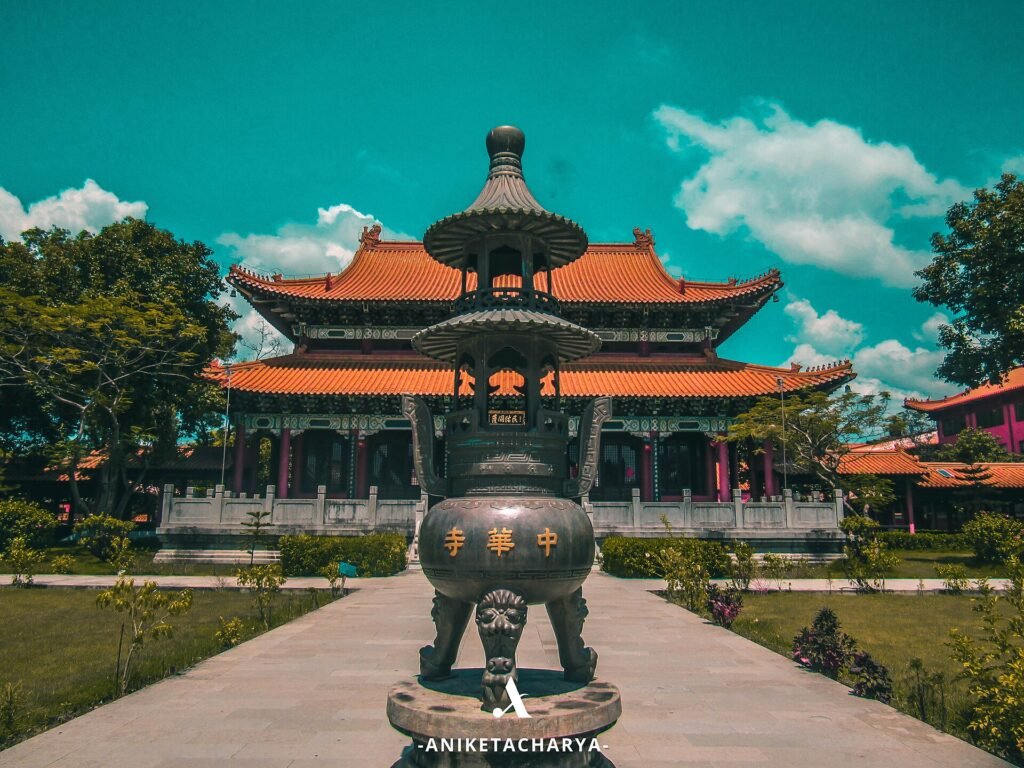
7. Zhong Hua Chinese Buddhist Monastery (China). Like a small Forbidden City, with a gate, courtyards and pagoda roofs. Often the busiest temple, so go early or late.
8. Dae Sung Shakya Sa, the Korean Temple (South Korea). One of the tallest buildings in Lumbini, with brightly painted ceilings and resident monks.
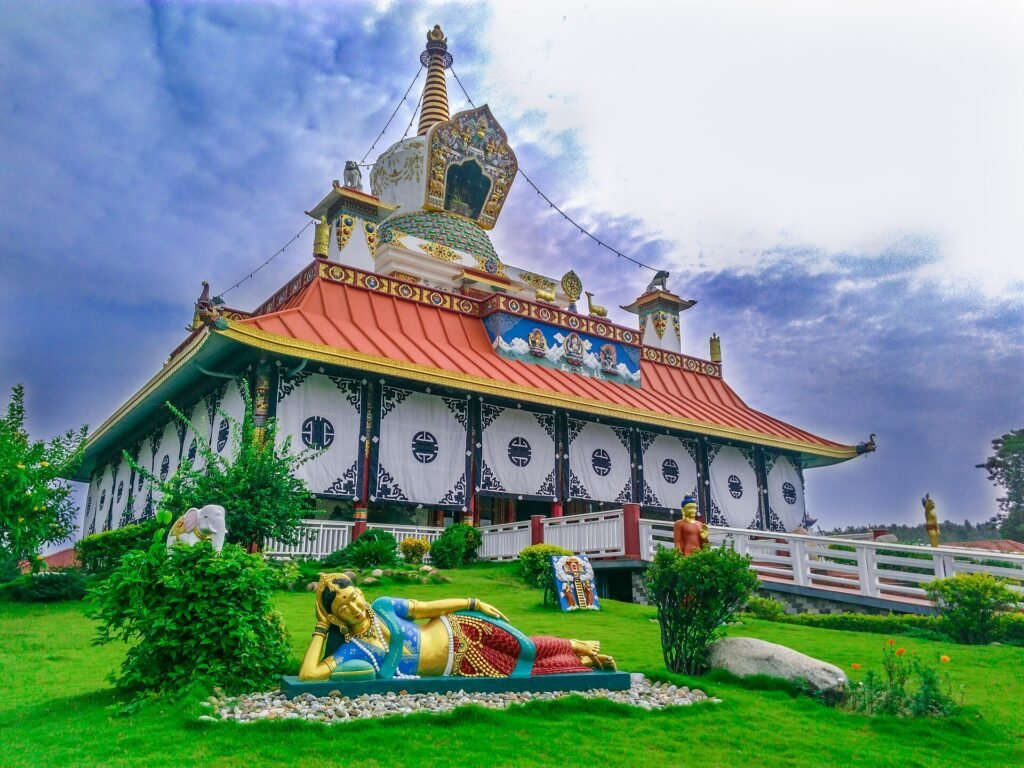
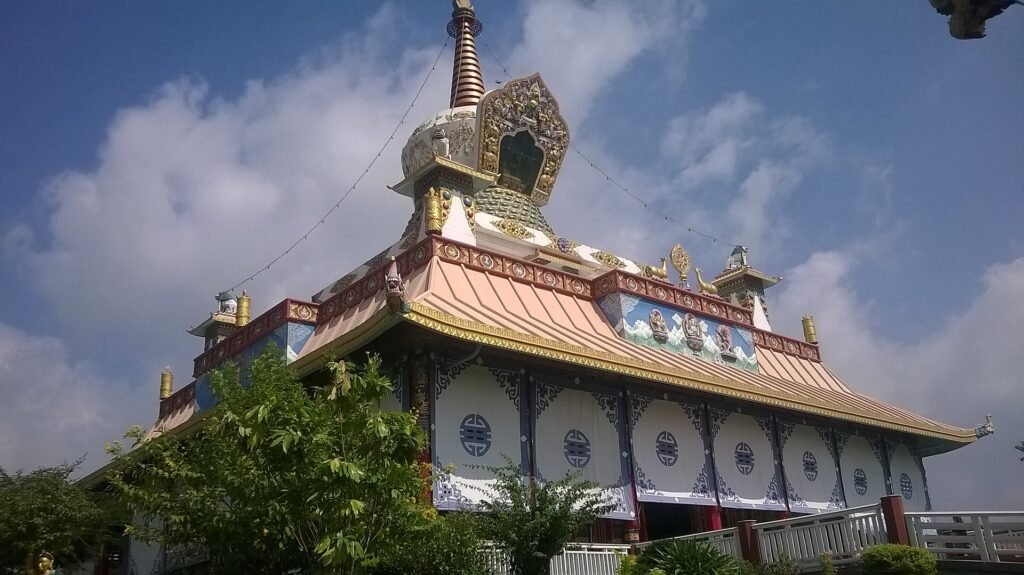
9. Great Drigung Kagyud Lotus Stupa (Germany). Built by the German Tara Foundation, with rich painting, gold and carving, partly covered by glass.
10. Vietnam Phat Quoc Tu (Vietnam). A grand roof, artificial rock mountains at the front and Vietnamese Buddhist art.
11. Thrangu Vajra Vidya Monastery (Canada). A Tibetan monastic college with red and gold murals. If monks are chanting, wait at the door and listen.
12. Manang Samaj Stupa (Nepal). Built by the Manang community from the high Himalaya, with a golden Buddha and colourful murals.
13. Geden International Monastery (Austria). An Austrian-backed monastery in the West zone. Usually quiet and uncrowded.
Near the Sacred Garden and in the north
14. Dharmaswami Maharaja Buddha Vihara (Nepal). Beside the Sacred Garden. Founded in 1968, it follows the Sakya school of Tibetan Buddhism and hosts the yearly ten-day Sakya Monlam prayers.
15. World Peace Pagoda (Japan). The large white stupa at the north end (see section 10).
Insider tip: Pick four or five temples that look completely different. You will remember more than if you rush through ten.
5. Which monasteries should you see first?
These ratings are our own opinion of what most first-time visitors enjoy. Five stars means “do not miss”.
| Monastery | Zone | Why go | Time | Rating |
|---|---|---|---|---|
| Myanmar Golden Temple | East | Golden spires | 30 min | ★★★★★ |
| Zhong Hua Chinese | West | Courtyards, pagoda roofs | 30–40 min | ★★★★★ |
| Great Lotus Stupa | West | Painted interior | 30 min | ★★★★★ |
| Royal Thai | East | White marble | 20–30 min | ★★★★☆ |
| Korean Temple | West | Huge, painted ceilings | 30 min | ★★★★☆ |
| World Peace Pagoda | North | Sunset | 45 min | ★★★★☆ |
| Vietnam Phat Quoc Tu | West | Rock mountains | 20 min | ★★★★☆ |
| Thrangu Vajra Vidya | West | Murals, chanting | 20 min | ★★★☆☆ |
| Sri Lankan | East | Simple dagoba | 15 min | ★★★☆☆ |
| Manang Samaj Stupa | West | Himalayan Nepali | 15 min | ★★★☆☆ |
| Cambodian | East | Khmer style | 15 min | ★★★☆☆ |
| Dharmaswami Vihara | Sacred Garden | Sakya monks | 15 min | ★★★☆☆ |
| Mahabodhi Society | East | Life of the Buddha | 15 min | ★★☆☆☆ |
| Gautami Nuns Temple | East | Quiet nunnery | 10 min | ★★☆☆☆ |
| Geden International | West | Uncrowded | 15 min | ★★☆☆☆ |
Insider tip: Pilgrims often want one temple from their own tradition. Put that first, then add the five-star stops.
6. When are the monasteries open?
Each monastery is run by its own community, so hours vary. Most follow the same pattern: open in the morning, closed for lunch, open again in the afternoon.
| Place | Usual hours (approx.) | Notes |
|---|---|---|
| Most monasteries | About 6–7 a.m. to 12 or 1 p.m., then about 2 to 5 p.m. | Some open later or close earlier |
| World Peace Pagoda | Open grounds | Best at sunrise and sunset |
| Eternal Peace Flame | Burns day and night | Best after dark |
| Maya Devi Temple | Opens early, closes in the evening | See our Lumbini stay guide |
Prices can change at any time. Hours and rules change with festivals, prayer times and the season. If one temple matters to you, ask at the Lumbini Development Trust visitor centre or call +977-71-404040.
Insider tip: Use the lunch break to eat, rest in the shade or ride north, not to stand outside a closed gate.
7. Etiquette and dress code
These are working temples where monks and nuns live and pray. Visitors are welcome as guests.
- Cover up: shoulders and knees, for men and women; you may be refused entry otherwise
- Shoes off: before shrine halls and in the Sacred Garden; wear slip-on shoes and carry socks for hot floors
- Walk clockwise: around stupas, shrines and prayer wheels
- Feet and heads: do not point your feet at a Buddha image or a monk, and do not touch anyone’s head
- Theravada temples: women should avoid touching monks or handing things directly to them
- Voices low: if prayers are going on, wait at the back or come back later
- Donations: welcome, never required
The Lumbini Development Trust also asks for modest, respectful clothing at the Maya Devi Temple. Loose cotton that covers you is respectful and cooler.
Insider tip: A thin scarf covers your shoulders inside temples and keeps the sun off your neck between them.
8. Can you take photos inside?
Outside, photography is allowed almost everywhere. Inside, the rules change from place to place.
- Maya Devi Temple: no photos inside the temple building
- Monastery halls: each temple sets its own rules; travellers have reported a ban inside the German Lotus Stupa, so look for signs and ask
- During prayers: do not photograph monks chanting or meditating without permission, and never use flash
- People: ask before photographing a monk, nun or pilgrim up close
- Camera fees: separate fees apply for video and professional filming; see the entry fees in our stay guide
- Drones: need permission from the District Administration Office, the Civil Aviation Authority of Nepal and the Lumbini Development Trust
Insider tip: The best light for white and gold buildings is the first two hours after sunrise and the last hour before sunset.
9. The Eternal Peace Flame, the canal and the boat
The Eternal Peace Flame burns at the southern end of the canal, near the Sacred Garden. The Nepal Tourism Board says it was lit in 1986, the International Year of Peace, and has burned ever since. Nearby is the World Peace Bell, installed in 2005.
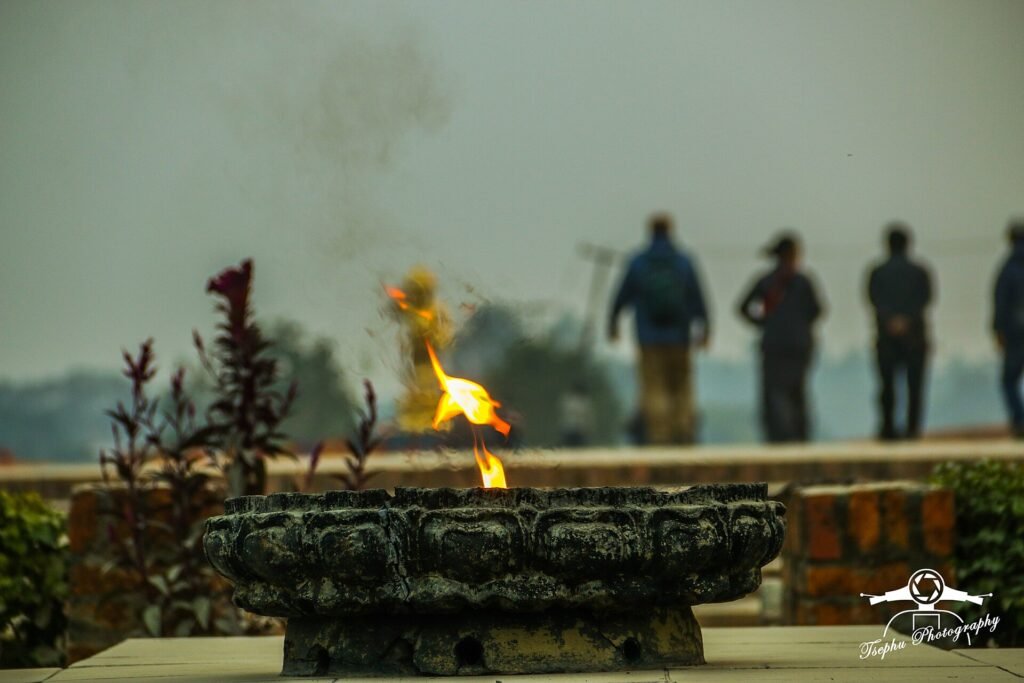
The central canal runs north from the flame between the two zones, crossed by brick arch bridges, with a paved walkway beside it.
The boat. Simple motor boats carry visitors along the canal, a nice way to rest your legs. A traveller guide updated in January 2026 reported a shared boat at about NPR 70 per person each way. There is no fixed timetable.
Prices can change at any time. Boat fares are set locally and can change. Agree the fare and the stop before you get in.
Insider tip: Come back to the Peace Flame after sunset if you can. It looks far better in the dark.
10. Is the World Peace Pagoda worth the ride north?
Yes, in the late afternoon. The World Peace Pagoda (Shanti Stupa) is a large white stupa built by Japanese monks of the Nipponzan Myohoji order for about one million US dollars, and dedicated in November 2001. Four golden Buddhas face the four directions.
It stands at the far north end of the plan, about 3.2 km from the Maya Devi Temple. A Japanese monk who was killed nearby during its construction is buried near its base.
- Best time: sunset, when the white dome turns orange and the paving has cooled
- Avoid: midday, when the stone floor is too hot for bare feet
- Combine with: the Crane Sanctuary, whose entrance is just before the pagoda gate
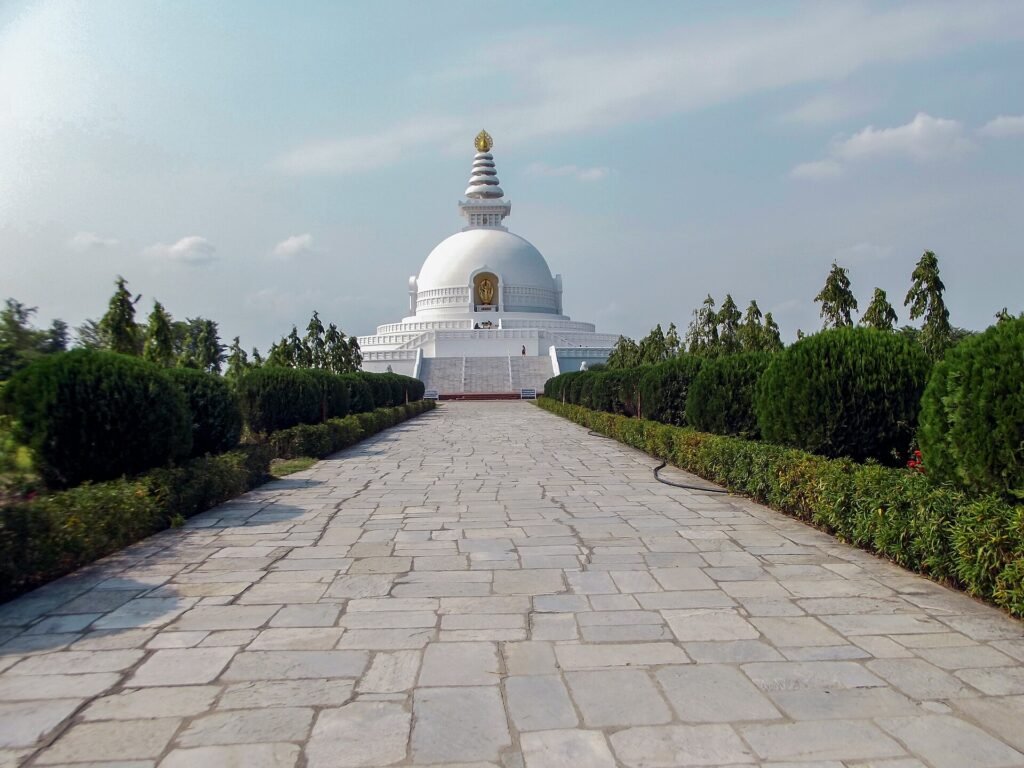
Insider tip: Walk the top terrace clockwise, slowly, and look out over the fields and wetlands.
11. The Lumbini Museum and the research institute
The Lumbini Museum is in the Cultural Centre at the north end, in a barrel-vaulted brick building designed by Kenzo Tange. Its collection includes terracotta figures, stone sculptures and ancient coins from Lumbini and Kapilvastu.
It has been under a long renovation. Work to retrofit the building began in January 2020, and the museum’s website still said “under renovation” when we checked in October 2026. Galleries may be open, partly open or closed.
The Lumbini International Research Institute (LIRI), next door, is a centre for Buddhist studies with a library of texts and manuscripts, run with the Japanese organisation Reiyukai. It is mainly for researchers.
Insider tip: Ask at the visitor centre whether the museum is open before riding north for it.
12. The Crane Sanctuary
Few visitors know it is there. The Lumbini Crane Sanctuary is a 256-hectare protected area inside the master plan, with five man-made wetlands. It protects the Sarus crane, the world’s tallest flying bird, grey with a red head.
- Managed by: the Lumbini Crane Foundation with the International Crane Foundation
- Birds: the Trust counts more than 200 species in the area
- Where: the wetlands near the World Peace Pagoda; follow the path to the watchtower
- Events: guided bird walks, nature trails and a yearly Sarus festival
Sarus cranes also feed in the rice fields around Lumbini. Details are on the Lumbini Development Trust page.
Insider tip: Bring binoculars and go early or in the last hour of light, when the birds are easier to see.
13. How do you get around, and what does it cost?
The zone is flat but long. The walkway alone is 1.6 km, temples sit back from the canal on wide plots, and the Peace Pagoda is over 3 km from the Sacred Garden. In cool weather you can walk a small loop. For more, use wheels.
| Option | Rough cost (as of October 2026) | Good for |
|---|---|---|
| Walking | Free | A small loop of 3–4 temples in cool weather |
| Bicycle | About NPR 200–300 per day | Stopping anywhere; the nicest way to see the zone |
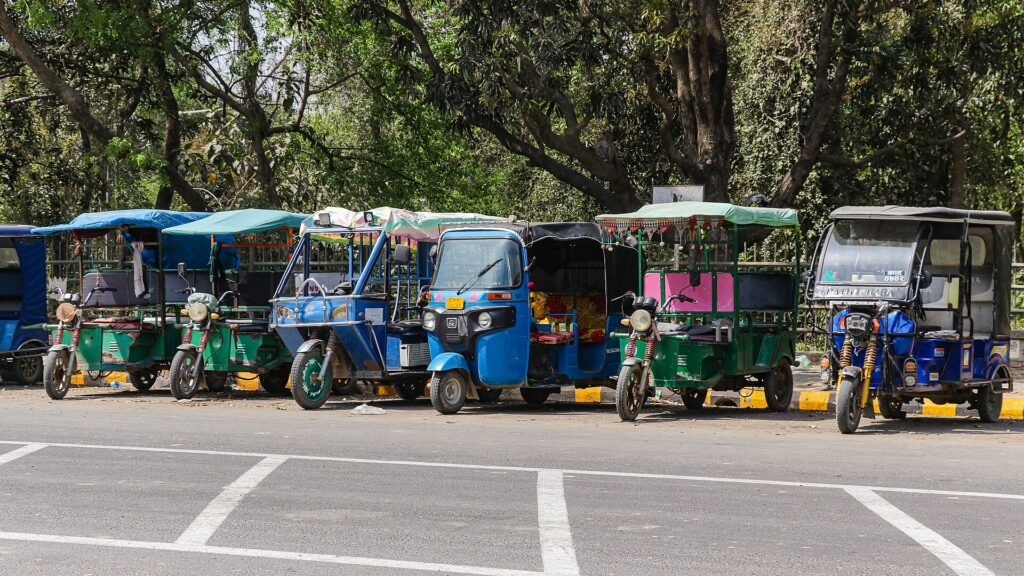
| E-rickshaw, half day | About NPR 600–1,000 for 3–4 hours | Most first-time visitors |
| E-rickshaw, full day | About NPR 1,200–1,500 | Both zones plus the Peace Pagoda |
| Canal boat | About NPR 70 per person each way | A rest between the two ends |
Prices can change at any time. Rickshaw and bicycle prices are not fixed by any official body and change with the season and demand. Agree the price, the stops and the waiting time before you start.
To reach Lumbini from Tilottama, Butwal or Bhairahawa you need a car. We can help you arrange one, and GoIndiaNepal provides private cars with English-speaking drivers in Nepal. For fair tips, see their guide to tipping drivers in India and Nepal.
Insider tip: E-rickshaw in the morning, when a driver who knows the way helps most; bicycle in the cooler afternoon, when you know the layout.
14. A half-day monastery route
Six of the best temples in one morning, finishing before the lunch closing. It assumes you see the Maya Devi Temple separately.
| Time | Stop | What you do |
|---|---|---|
| 7:00 | Eternal Peace Flame | Start at the south end of the canal; hire your ride nearby |
| 7:15–8:00 | Myanmar Golden Temple | Golden spires in soft light |
| 8:00–8:30 | Royal Thai Monastery | White marble, quiet lawns |
| 8:30–8:45 | Cross the canal | Use a brick bridge to the West zone |
| 8:45–9:30 | Zhong Hua Chinese Monastery | Courtyards before the groups arrive |
| 9:30–10:15 | Korean Temple | Painted ceilings, huge hall |
| 10:15–11:00 | Great Lotus Stupa | Walk around it slowly |
| 11:00–11:30 | Vietnam Phat Quoc Tu | Last stop before the heat |
Insider tip: Starting later? Do the West zone first, while the Chinese temple is quiet, and finish in the calmer East zone.
15. A full-day route
A full day covers the birthplace, both zones and the north end, with a rest through the hottest hours.
| Time | What you do |
|---|---|
| 6:30–8:00 | Maya Devi Temple and the Sacred Garden (tickets: see our Lumbini stay guide) |
| 8:00–8:30 | Dharmaswami Maharaja Buddha Vihara and the Eternal Peace Flame |
| 8:30–10:30 | East zone: Myanmar Golden Temple, Royal Thai, Sri Lankan, Cambodian |
| 10:30–12:00 | West zone: Chinese Monastery and Korean Temple |
| 12:00–14:00 | Lunch and rest; many temples close |
| 14:00–15:30 | Great Lotus Stupa, Vietnam Phat Quoc Tu, Manang Samaj, Thrangu |
| 15:30–16:45 | North by boat or walkway; museum (if open) and the crane watchtower |
| 16:45–sunset | World Peace Pagoda |
Insider tip: Book one rickshaw driver for the whole day. He waits during lunch and takes you north for sunset without a new price discussion.
16. Meditation centres and monastery stays
Dhamma Janani (Lumbini Vipassana Centre) in the East zone teaches Vipassana in the Goenka tradition. It opened in 2000 and runs regular 10-day silent courses, free and on a donation basis. Apply in advance on the Dhamma Janani schedule, which lists courses through 2027.
Panditarama Lumbini International Vipassana Meditation Centre, run from Myanmar in the West zone, follows the Mahasi Sayadaw tradition. Retreats are usually at least seven days, with talks in English, on donations. Space is limited, so contact them well ahead; teachers often travel between April and June.
Informal meditation. Many monasteries let visitors sit quietly in the main hall when no ceremony is on. Ask first.
Staying at a monastery. The Korean Temple has offered simple dorm beds and meals to visitors for years, usually for a small donation, with shared bathrooms and early wake-up bells. Reports of the cost differ widely. For hotels and guesthouses, see where to stay for Lumbini.
Prices can change at any time. Monastery stays and courses are run by each community. Donations and rules can change without notice, so contact them before you count on a bed.
Insider tip: New to meditation? Start with an hour in a monastery hall at dawn. The Trust also sells a 12-day meditation pass for longer stays; the price is in our Lumbini fees guide.
17. Best season and time of day
| Season | Months | For monastery visits |
|---|---|---|
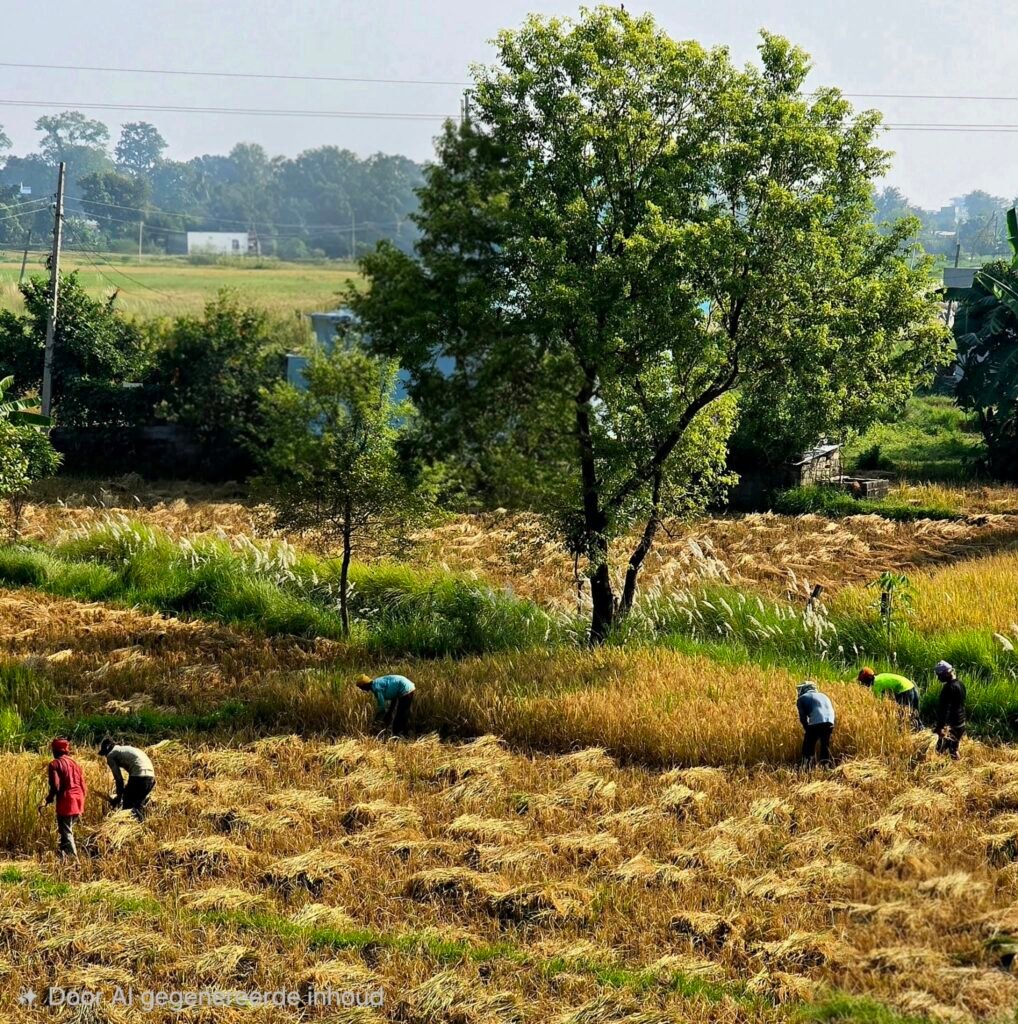
| Autumn | October–November | The best time: clear skies, warm days, golden fields |
| Winter | December–February | Pleasant days, cold mornings, fog until mid-morning |
| Spring | March–April | Warm, hot by April; Buddha Jayanti often falls in April or May |
| Summer | May–June | Very hot; early morning and evening only |
| Monsoon | July–September | Heavy rain at times, very green, few visitors |
- Best time of day: the first two hours after opening and the last two before sunset
- Worst time: 11 a.m. to 3 p.m., with hot paving and lunch closures
- Busiest day: Buddha Jayanti; the Dhamma Janani schedule lists it on 20 May 2027
Insider tip: In winter, start the monasteries mid-morning when the fog lifts, and keep the Peace Pagoda for the afternoon sun.
18. Visiting the monasteries from Greenkunja
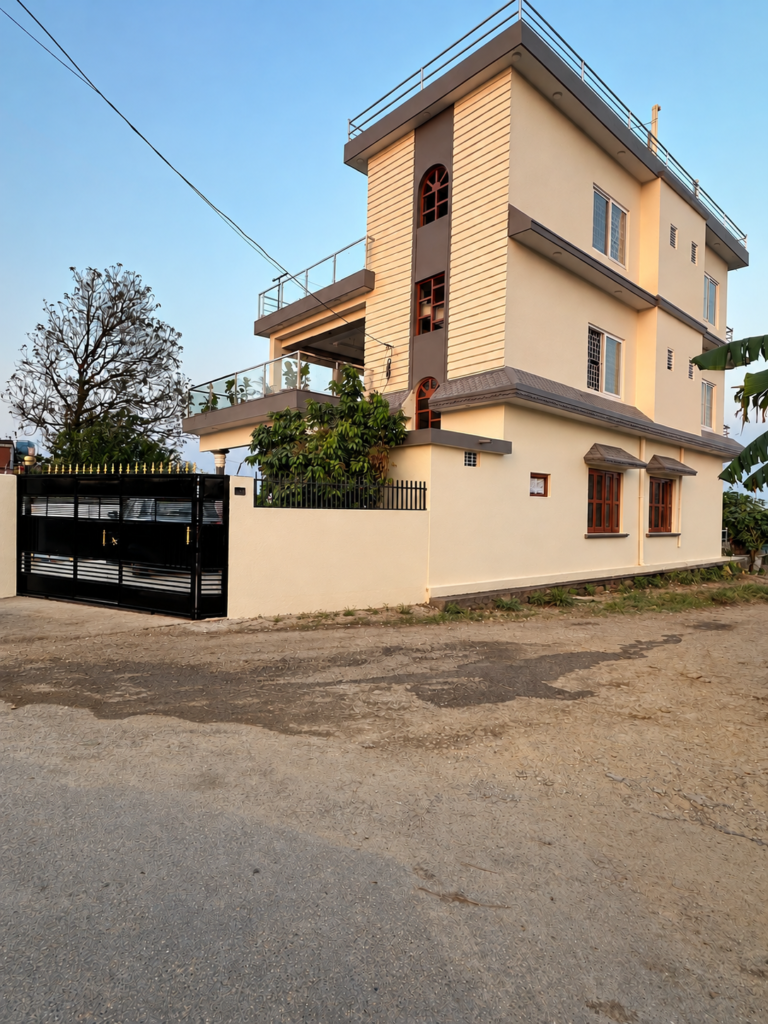
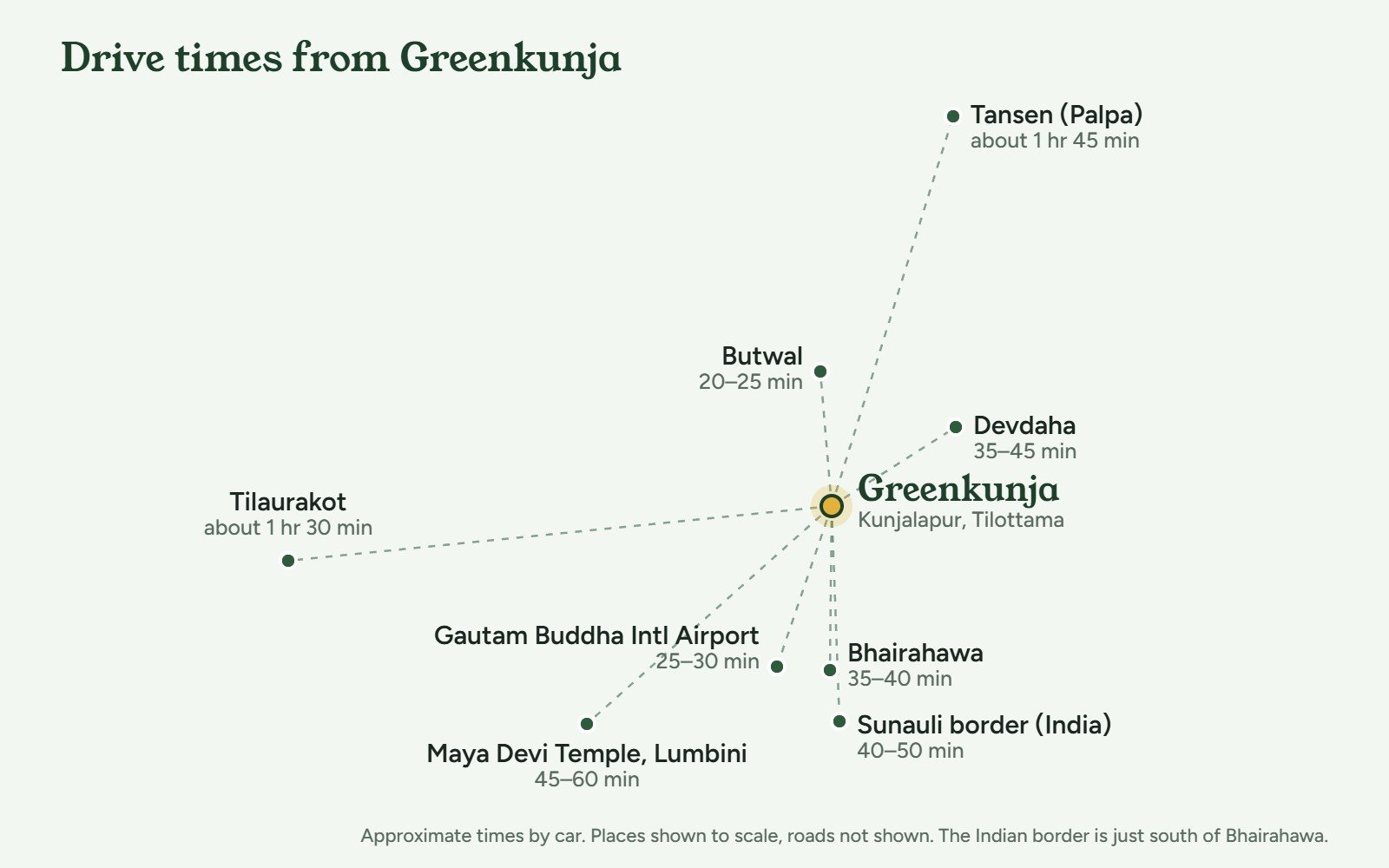
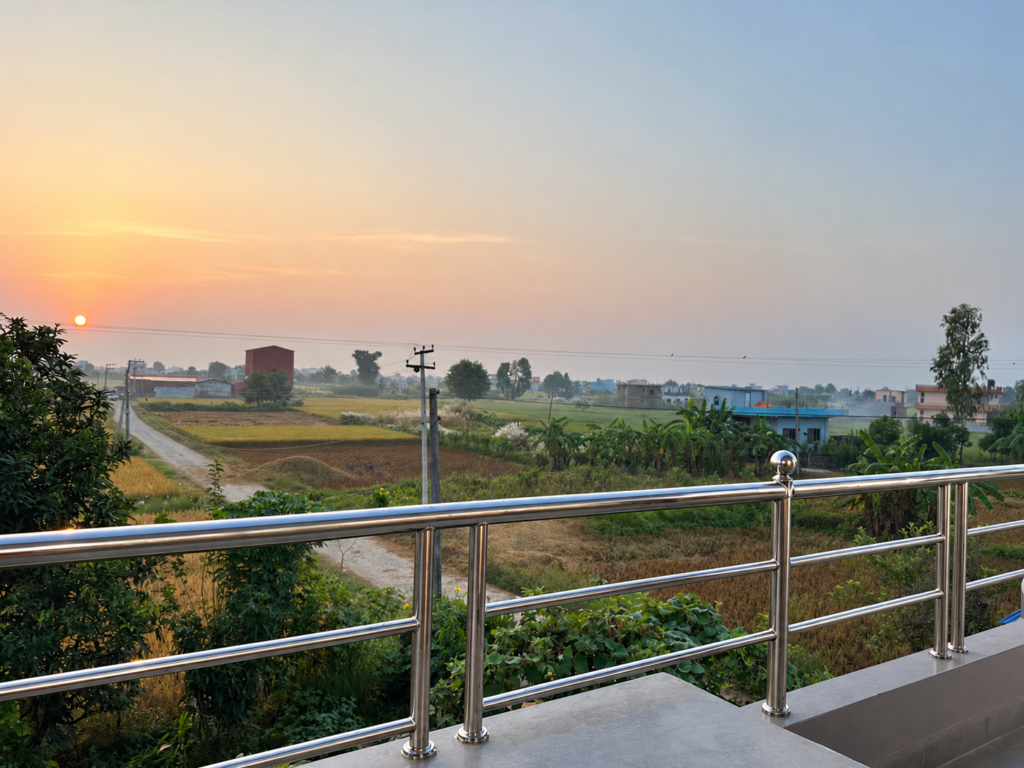
Greenkunja is our family guesthouse in Kunjalapur-6, Tilottama, between Butwal and Bhairahawa. It is not in Lumbini: the monastic zone is a 45–60 minute drive. In return you get a quiet room among rice fields after a long day of temples.
| From Greenkunja to | Distance (approx.) | Drive (approx.) |
|---|---|---|
| Maya Devi Temple and the monastic zone | 30–35 km | 45–60 min |
| Gautam Buddha International Airport | 15 km | 25–30 min |
| Central Butwal | 10 km | 20–25 min |
| Sunauli–Belahiya border (India) | – | 40–50 min |
To reach the Sacred Garden by 6:30–7:00, leave at about 6:00. See the room and photos.
Insider tip: Tell us the night before which route you plan, and we can help you arrange a car for the right start time.
19. How Greenkunja and GoIndiaNepal fit in
Greenkunja is a good fit if you want a calm, green base for two or more nights, you are travelling by car, or you are breaking a long journey between Chitwan, Pokhara and India.
You may be happier elsewhere if you want to cycle from your door to the monasteries at sunrise (stay in Lumbini village), you are joining a meditation course (stay at the centre), or you are a large group (we have one room open for now).
For a longer trip, our family company GoIndiaNepal has run private tours with a car and driver across India and Nepal since 1996:
| Tour | Route | Good for |
|---|---|---|
| Buddhist Circuit Tour, 9 days | Varanasi, Sarnath, Bodh Gaya, Nalanda, Kushinagar, Lumbini | Pilgrims |
| Varanasi to Kathmandu by Road, 7 days | Varanasi, Kushinagar, Lumbini, Chitwan, Kathmandu | Crossing overland |
| Nepal Cultural Odyssey, 12 days | Kathmandu, Bandipur, Pokhara, Lumbini, Chitwan | A first trip to Nepal, with a full day in Lumbini |
| Nepal tours | Kathmandu, Pokhara, Chitwan, Lumbini and more | A trip shaped around you |
| India and Nepal tours | Both countries with one company | Combining the two |
Starting in India? Our Private India Tours with Driver: Golden Triangle & Rajasthan can end at the Nepal border so you continue to Lumbini. See also the India and Nepal pilgrimage guide and the 14-day India and Nepal itinerary.
Insider tip: Not sure what fits? Send us your dates and route, and we will tell you honestly where to stay.
Get a Fixed Price
Tell us your dates, how many of you are travelling, and which monasteries you want to see. We will reply with a fixed price for your room, and for a car and driver if you need one. WhatsApp +91 98109 09368 (our family’s WhatsApp, answered in Nepal and India) or email info@greenkunja.com. You can also see the room and how to book.
The room is listed on Booking.com at about USD 29 a night, with breakfast listed (continental, English or from the menu).
Prices can change at any time. The rate changes with the season, dates and number of guests. Check Booking.com or ask us on WhatsApp.
Plan Your Lumbini Monastery Day in Just 3 Steps
- Tell us your dates and where you are coming from.
- We suggest a plan: half or full day, which temples, and whether you need a car, with a fixed price.
- Confirm and relax. Your room is ready when you arrive.
Your Lumbini Monasteries Checklist
- Have you chosen four to six temples that look different?
- Are you starting before 8 a.m.?
- Have you planned a rest between about 12 and 2?
- Have you agreed the rickshaw price, stops and waiting time?
- Do your clothes cover your shoulders and knees?
- Are your shoes easy to slip off, and do you have socks for hot floors?
- Do you have small notes for donations and the boat?
- Have you checked the current entry fee for your nationality?
- Have you left the drone at home?
- Have you saved the World Peace Pagoda for sunset?
Summary: A Simple Way to Think About It
Tange’s plan puts the birthplace in the south, the monasteries in the middle and the Peace Pagoda in the north, joined by one canal. Theravada temples are on the east side, Mahayana and Vajrayana on the west. Start early, pick five temples that look different, rest through lunch, and finish at the Peace Pagoda at sunset.
Frequently Asked Questions
How many monasteries are there in Lumbini?
The Nepal Tourism Board counts about 32 monasteries and meditation centres built or under construction on 42 plots: 13 in the East zone and 29 in the West. New ones are still being added.
Which Lumbini monasteries are the best?
For a first visit: the Myanmar Golden Temple, Royal Thai Monastery, Zhong Hua Chinese Monastery, Korean Temple and Great Lotus Stupa. Add the World Peace Pagoda at sunset.
What is the difference between the East and West zones?
The East zone is for Theravada Buddhism, from Sri Lanka, Myanmar, Thailand and Cambodia. The West zone is for Mahayana and Vajrayana Buddhism, from China, Korea, Japan, Vietnam and the Himalaya.
Do you pay to enter the monasteries?
No. The monasteries are free, and a small donation is welcome. There is a separate conservation fee for the Lumbini Development Zone; our where to stay for Lumbini guide lists it.
What time do the monasteries open?
Most open early in the morning, close for one to two hours around lunch, and reopen until about 5 p.m. Hours differ and can change at festivals.
What should I wear?
Cover your shoulders and knees, men and women alike. Wear shoes that are easy to take off.
Can I take photos inside?
Outside, yes. Inside, it depends on the temple, so look for signs or ask. Photos are not allowed inside the Maya Devi Temple, and drones need permission.
How long do I need?
Half a day covers five or six temples by bicycle or e-rickshaw. A full day adds the Sacred Garden, both zones and the Peace Pagoda at sunset.
How much does an e-rickshaw cost?
As of October 2026, guides report about NPR 600–1,000 for a half day and about NPR 1,200–1,500 for a full day. Agree the price and stops first.
Can I rent a bicycle?
Yes, usually near the entrance or through hotels, for about NPR 200–300 a day as of October 2026. Check the brakes before you ride off.
What is the Eternal Peace Flame?
A flame at the southern end of the central canal, lit in 1986 for the International Year of Peace and kept burning since. It is best seen after dark.
Can I stay overnight in a monastery?
The Korean Temple has offered simple dorm beds and meals for years, usually for a donation. Arrangements change, so contact the monastery first.
Can I do a meditation course in Lumbini?
Yes. Dhamma Janani runs free 10-day Vipassana courses on donations, and Panditarama runs retreats of at least seven days. Apply or contact them in advance.
Is the Lumbini Museum open?
It has been under renovation since 2020, and its website still said so in October 2026. Ask at the visitor centre before you go.
Before You Go
The monastic zone is not a museum of buildings. Monks from Myanmar, Korea, Thailand, Tibet and Nepal live side by side here, a short walk from where the Buddha was born. The visitors who enjoy it most slow down: one temple, one quiet hall, one cup of tea in the shade, then the next.
And if you want a quiet room among the rice fields to come back to, we would be happy to welcome you to Greenkunja.
Fewer temples. More time in each.
Ready to plan your Lumbini monastery day? WhatsApp +91 98109 09368 or email info@greenkunja.com with your dates. We will reply with a fixed price for your room, and help you arrange a car if you need one.
More travel guides from our family
- Where to stay for Lumbini: areas, prices and entry fees (Greenkunja)
- Private India Tours with Driver: Golden Triangle & Rajasthan (GoIndiaNepal)
- Places to visit in Nepal (GoIndiaNepal)
- Pokhara travel guide: Phewa Lake and Sarangkot (GoIndiaNepal)
- How to plan a combined India and Nepal trip (GoIndiaNepal)
- India and Nepal travel trends 2027 (GoIndiaNepal)
- Best treks in Nepal for beginners (GoIndiaNepal)
- Greenkunja Guesthouse: the room, photos and booking